SOMM Recordings’ new series, “Elgar from the Archives,” explores Edward Elgar’s music with rare archival recordings, not only from well-known British interpreters but also from lesser known, yet equally laudable, international conductors and soloists.
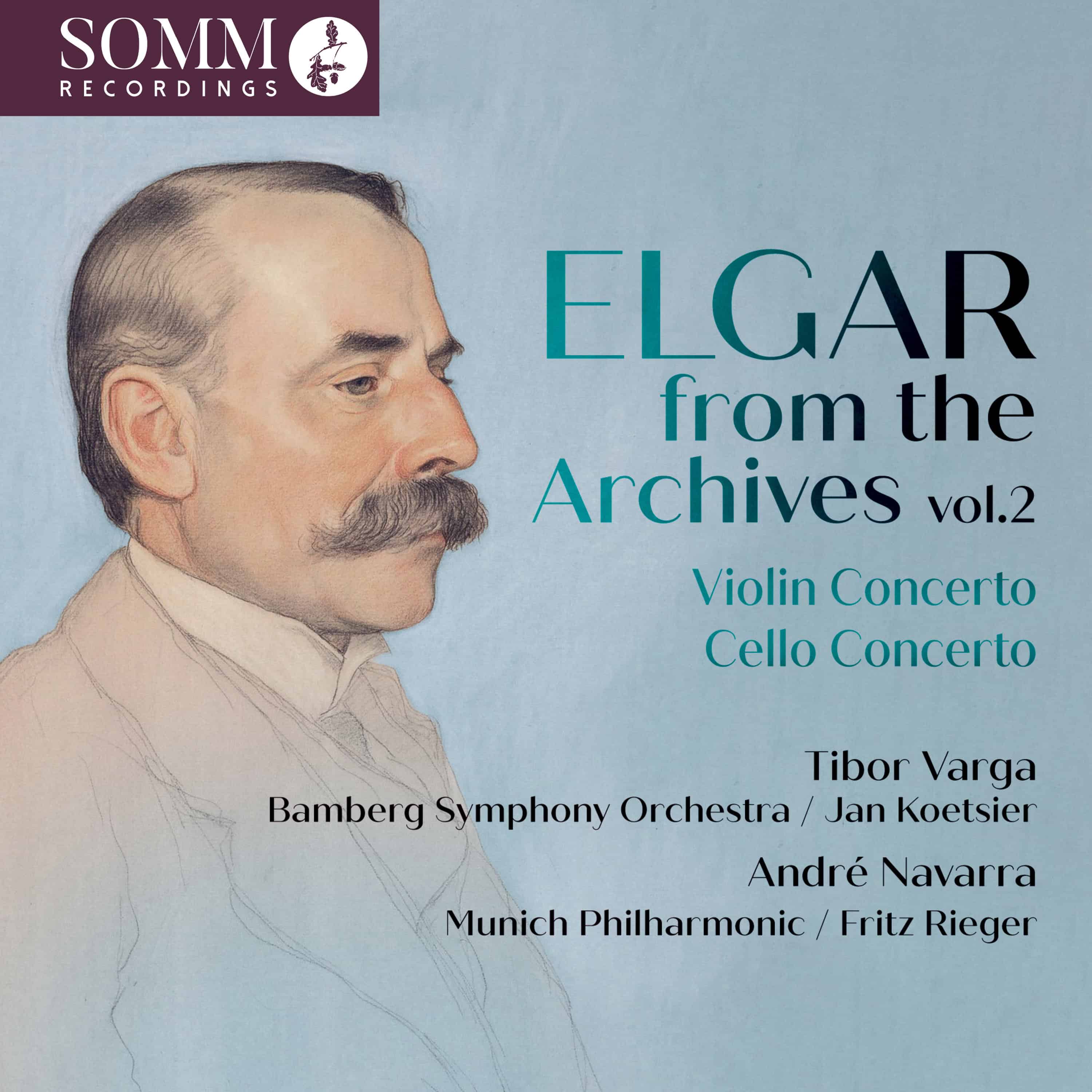
Volume 2 in the series features historic live performances of Sir Edward Elgar’s Violin Concerto in B minor, Op. 61 with Tibor Varga, and the Cello Concerto in E minor, Op. 85 with André Navarra. Lani Spahr—whose work as a master recording engineer of historic reissues has been honoured by Gramophone Magazine—has once again expertly realised the audio restoration of these performances.
The Royal Philharmonic Society of London commissioned the Violin Concerto from Elgar in 1909. Composed within a year of his First Symphony, it is one of his longest orchestral compositions and has the reputation of being one of the most difficult in the violin repertoire. He dedicated it to the noted violin master of his day, Fritz Kreisler, who gave the premiere performance in 1910 with Elgar conducting.
The Hungarian violinist Tibor Varga (1921-2003) was 6 years old when he made his first public appearance, becoming one of the most prominent soloists of his generation. The Franz Liszt Academy appointed him an honorary professor—a rare distinction also awarded to Elgar, Emil Gilels, Richard Strauss, and Arturo Toscanini, amongst others. Varga moved to London in 1947, became a citizen, and lived in Britain for nine years. That experience is reflected in his fine, committed performance of Elgar’s concerto. This recording, from 1957, is with the Dutch composer and conductor Jan Koetsier and the Bamberg Symphony Orchestra.
Following the Great War, Lady Elgar noted that her husband’s compositions were different in style and character. His four-movement Cello Concerto, completed in 1919, is barely longer than the first movement of his Violin Concerto, and it is a contemplative, elegiac work with a heartfelt third-movement adagio that is a masterful example of controlled emotion. Yet the concerto ends on a positive note, as the declamatory opening returns in a valedictory form at the end of the finale.
The renowned cellist André Navarra (1911-1988) graduated from the Paris Conservatoire at the age of fifteen, and he was later mentored by Pablo Casals. He toured extensively in the United States, Europe, Asia, and the Soviet Union, playing with the great conductors of the era, and he was one of a number of distinguished French cellists who embraced the Elgar concerto. He chose it for his first public performance in Britain at the 1950 Cheltenham Festival with John Barbirolli—with whom he recorded the concerto in 1957. His recording here with German conductor Fritz Rieger and the Munich Philharmonic Orchestra, comes from 1956.
On This Recording
Cello Concerto in E Minor, Op. 85 (25:46)a
- I. Adagio – Moderato (7:13)
- II. Lento – Allegro molto (4:21)
- III. Adagio (4:33)
- IV. Allegro – Moderato – Allegro, ma non troppo – Poco più lento – Adagio (9:38)
Violin Concerto in B Minor, Op. 61 (46:52)b
- I. Allegro (17:31)
- II. Andante (11:22)
- III. Allegro molto (17:58)
aAndré Navarra, cello; Munich Philharmonic; Fritz Rieger, conductor
bTibor Varga, violin; Bamberg Symphony Orchestra; Jan Koetsier, conductor